gluttony, thy name is arturo

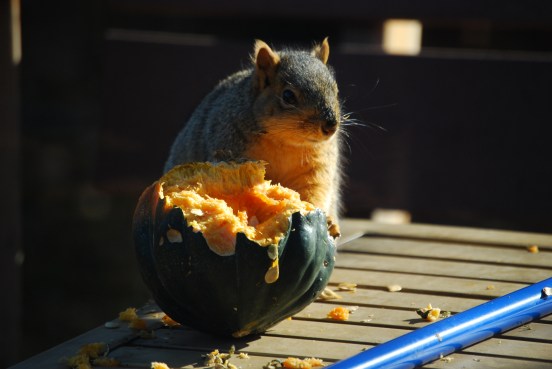
On Thanksgiving day, Arturo decided to make his move and get to the nougaty center of seeds inside the acorn squash.  He tolerated a few pictures through the glass, so they’re a bit hazy.

2013 November 032

Although a gallery of his henchmen, four of them, sat on the fence, drooling in anticipation of finishing what he did not eat, none dared interrupt the Godfather’s meal.  Zora couldn’t photobomb the event because she was out on a walk. He sat for almost a half hour and ate more than his body weight.

2013 November 031

I still can’t figure out how he crammed that much into his being.  He only stopped once to shake his fist and beat his chest at those fellas on the fence.  Or maybe they were ladies.  It’s hard to say.  But there was for sure some kind of exchange that involved threats and cussing, after which the gallery on the fence sat skulking, perhaps plotting their revenge.

2013 November 040

Unfortunately, his girth, jewels, and gold chain are mostly hidden.

2013 November 042

We were getting along so well, I tried to open the door and join him on the deck.  His mouth is closed here, but he had just told me to step the (*&^%$ off.  The next step, I’m pretty sure, was to pick up that blue broom handle and beat me.  So much for all that nonsense about the hand that feeds.

2013 November 049

Arturo seems to have a good handle on what Thanksgiving is all about.  After he ate, he waddled off the deck and managed to climb the big oak in the backyard.  I can’t imagine he could do anything else but sleep off his binge.  This is what he left for the fence-squatters, who gave themselves several minutes before coming down to brave the leftovers without getting their asses kicked.

By the time we finished our own Thanksgiving feast and went out to see what was left, the whole thing was gone.  There wasn’t so much as a seed left.

Arturo’s bar is officially closed for this year.  He’s going to have to go back to foraging for nuts as nature intended.  But it makes me wonder, if he can make such quick work of a little squash, what could he do with something much bigger, like a butternut or turban? Maybe next year I’ll go for broke, leave out a pumpkin the size of Arkansas, and see what kind of tomfoolery will come of that.

Categories: gardening, nature, outdoors | Tags: , | 2 Comments

the shoulds

2012 India Trip #3 025

My feet and hands, a little rough and scarred with the miles, are evidence of my wonky pursuits.

Being pampered doesn’t often rank as a way to spend time, but last summer I tagged along with a friend to a salon so we could soak our feet, have the skin on our heels scrubbed with a cheese grater, get our nails painted.  Above the sound of the motorized massage chair and the bubbles in the foot bath, we chatted, catching up while flipping through smutty magazines.  On a stool below me, a very small woman set to work on my feet, clucking about the dead toenails and calluses (thank you, running).  Ill at ease with the perch on my vibrating throne, I tried to engage her in conversation, made difficult by my general discomfort in salons, and also by the language barrier.

When I asked her about her day, she smiled and shook her head and pointed to the bottle of polish I’d picked.  “Empty,” she said, and then went to find another.

After that, I gave myself over to the experience of having my lower legs rubbed with exfoliating scrub and the pedicurist’s deft hands loosening up a tight calf muscle.

Next to us in the bank of chairs sat another woman, older by twenty years or so, who greeted us when we arrived and then sat reading a magazine while her feet were worked over.  Her long, white hair was tied back in a loose ponytail.

A half hour later, we all sat around the drying table together, cotton wedged between our toes, our flip flops on.  It was June.  The kids were about to be out of school, a busy time for families.  My friend and I were lamenting our long list of things to accomplish before summer officially began.

At a lull in our conversation, the white-haired woman leaned toward us and said, “I used to talk the same way.”

We assumed she was referring to our kavetching about kids, summer, or the eighty-seven end-of-year projects and parties.

“But one day,” she went on, “this wonderful friend of mine said to me, ‘Why do you do that?’”

In the pause that followed, I filled in the blanks for what she meant by that. Why did we make ourselves so busy?  Why did we bitch about our kids in public?  Why were we talking about Hollywood stars as if we knew them?

She leaned down and disentangled the cotton from her purple toes, then sat back up.  “Think about it this way,” she said, “there is what you need to do, and there is what you want to do.  But should?  This is a word you can take out of your vocabulary.”

“It sounds good,” my friend said, “but I have a big-ass list of things I should do today.  I definitely don’t want to do them.”

“Yeah,” I chimed in.  “I don’t know if I could break up with should.  I mean, what would I complain about?”

I considered her perspective, doubting its merit.  My life was full of what I should be doing instead of getting a pedicure.  Like playing hooky, escaping from the shoulds was part of the thrill.  In truth, the weight of my obligations felt heavy.  I’d been thinking for months about how to disconnect gracefully from several commitments, which involved going head to head with my guilt-lined Lutheran upbringing.  It’s an ugly, ongoing skirmish.  Also, I was kind of pissed.  I mean, I went to the shop with my friend to relax and not feel shitty, and here was this woman life-coaching me.  Who did she think she was anyway?

The white-haired woman nodded.  She reached into her purse and took out her wallet.  “Those are probably things you need to do. Go to work, clean the house, pick up your kids, make dinner.  Right?”

“But I should do them,” my friend said.

Gathering her things together, the woman shook her head.   “Try it, girls.  It’s very freeing.  Now I think of the world in a totally different way.  Before, I spent a lot of my time fulfilling the obligation of should.  It takes practice not to, because we’ve all been at this kind of thinking for, well, our whole lives.”  She paid the gal who’d worked up her feet, waved a goodbye to us, and left the shop.

My friend and I sat looking at each other for a moment.  “I bet she cruises the nail shop circuit,” she said. “She’s like a salon prophet or something.”

“Or full of shit,” I said.  “And also clearly has no relentlessly hungry kids to feed.  Probably gets her toilets cleaned by someone else.”

After we left the shop, I filed this encounter away, chocking the white-haired woman’s advice up to a world view of someone who didn’t pressure herself too much.  The bored rich.  A woman who read a lot of self-help stuff and hired out for every last thing.

Except I didn’t really believe that.  I kind of liked her calm, self-assured way of being, and also that she hadn’t dyed her hair or cut it super short to tame the wire out of it.  She seemed like someone I might be friends with.  We’d only had a few minutes’ exchange with her, but her words worm-holed within me all summer and into fall.  I couldn’t say should without thinking of her, without pausing to reframe my sentiment and edit out the shoulds.

Lately, John and I have been talking with Owen about choosing a college, about what he’d like to do in the world.  Our advice to him has always been to seek a path of joy and fulfillment, as well as one that will make him a living.  Every time we have this conversation with Owen, though, I can’t help but think to myself about the similar, parallel path of partnering need and want.

At the risk of seeming like a white-haired lady groupie, it occurs to me that fulfillment comes when want and need intersect in a singular pursuit or practice, and that this is a rare, precious thing.

Of course, it’s hard to hit the right groove all the time.  The dailyness of life isn’t all rainbow brilliant, shot full of light and unicorns and feel-goodery and self-worth.  My kids make me crazy. The state of the world is scary.  Fully in touch with my inner bitch, I’m not nearly as patient, loving or kind as I aim to be.

But living with purpose serves me well most of the time.  I need and want to raise thinking, compassionate kids in the world.  I need and want to write.  I need and want to garden, to know how to do things for myself, to be a good friend, to travel and know the world, to go outside and teach kids how to do the same.  There’s little room for should in any of these passions.

I haven’t quite been able to get to the same level of bliss about cleaning, driving or laundry, but it could come for me someday.

Meanwhile, in this season of thanks, I’ll sit down to the table with my family, enjoy a meal we’ve all pitched in to prepare, and know as certainly as I know anything that I both need and want to be spending my time this way.

2013 November 067

Categories: community, family, girls, parenting, writing | Tags: , , , , | 4 Comments

arturo

what yearning looks like

what yearning looks like

For our dog Zora, spring and fall are full of yearning.  Each cusp season, she becomes a quivering, drooling, yowling mass of desire. She desires cats.  She desires birds.  She desires the mail carrier.  But what she desires most is squirrels.  Whatever constellation of breeds she’s sprung from has programmed her to believe  she will actually win a squirrel.  Any day now.

Training for the big day involves a regimen of smearing the glass with her nose to track squirrels in the backyard, whine-singing a song that will lure them to her, hurling herself at the fence they like to traverse, and going in and out twenty times a day to monitor the premises.  There are also hours of daintily gumming a stuffed chipmunk she’s had since we got her five years ago.  Other toys roughly approximating real animals have died quick deaths in a blaze of stuffing and plastic parts.  But Chippy is very precious –she would never fully ingest it.  Chippy’s squeaker is broken.  Chippy is also missing an eye and part of an ear, and looks a little an object used to foreshadow murder in a bad horror film.  It makes me wonder what she’d actually do if she managed to catch the real thing.

Zora spent the first month she came to live with us wearing a muddy track from the mimosa tree to the telephone pole to the gate to the garden in the backyard.  We’d just redone the landscaping, which she destroyed.  Her sole quest was chasing gray squirrels, especially a pair that came to play every morning about the same time.  One day I came home to find the three of them faced off, Zora crouched at the base of the telephone pole, the squirrels immobile, noses touching, fifteen feet up.  No one moved for three hours.

At our new house we also have squirrels, red ones, who make their gray cousins seem lazy and stupid.

It wasn’t long after we moved in that we met the new object of desire.  Arturo.  He’d come calling mid-morning, squatting by the back door while eating a sunflower head from our garden and looking at us through the glass.  Which is to say he was very close to the glass.  So close he used the window as leverage to extract seeds, never taking his eyes off our lives inside.  This, of course, was a thrilling new development for Zora, who could somehow hear him no matter where she was in the house.  Arturo would stay an extra beat, watching her smash herself into the glass, frothing at the mouth, just on the other side of his nuts, before he’d scamper off the deck and up into the oak tree.

Although I do often name things when I get the itch (We have a lamp called Celeste, I’m not sure why.  My truck’s name is Stella.  John’s mountain bike’s name is Jolene, as in please don’t steal my man…), I’ve never named a squirrel before.  I don’t know why Arturo is this creature’s name, except that he is VERY distinct.  He is easily the largest squirrel I’ve ever seen.  I mean, almost the size of a small house cat.  Despite his girth, he’s fast enough to still be alive, savvy enough to dodge all my attempts at taking his photo, and very decidedly the boss of this territory.

Arturo still comes calling every day, to the delight and crazed desire of Zora.  On the deck we’ve left an acorn squash that fell out of a shopping bag, one he quickly helped himself to, so he’s got extra inducement to make an appearance.  He’s clearly getting enough to eat.  He’s bigger than ever, even for a squirrel preparing for winter.  I’m a little worried about how much more weight he can gain and still get the job of squirreling done.

arturo's snack bar

arturo’s snack bar

Lately, he’s taken to sitting up on the fence near the deck.  Other squirrels in Arturo’s posse hang out there too, though not when he’s there.  In pairs usually, they run along the fence, making a chittering racket, doing a snake-charmer thing with their tales, dancing squirrel hip-hop with their back feet.

Arturo is always alone.  And he never does any hoorahing.  He just sits.  His posture is much the same as the sunflower seed window squatting, but his safer vantage point gives him extra time to taunt Zora.  Seemingly unperturbed, he eats, unblinking, languorously, while Zora throws herself against the fence beneath him, begging him to come down.

From the kitchen window the other day, I watched Arturo sitting on the fence, surveying the yard like some kind of mob boss while he consumed an entire chestnut.  It was a long squat, even for Arturo.  Maybe he’s got henchmen to deal with the Red-tails and Cooper’s hawks that troll the yards around here.  Maybe he thinks he can take out any house cat that crosses him.  It’s hard to say.

But he was clearly feeling very comfortable, because hanging down and resting against the fence was his massive nut sack.  I had no idea male squirrels could possess such impressive jewels.  But they there were, huge and hairy and disproportionate to his frame, on display as if was a rodent porn star.

I’m not going to contact Guinness Book of World Records or anything, though a quick online search tells me I’m not the first to be stunned by squirrel genitalia.  Arturo’s junk puts every photo I saw on the interwebs to shame, though.  Also, according to Uncle Google, red squirrels are supposed to be smaller than gray squirrels, and they’re more territorial than most species.  They store their booty in caches crammed with nuts, called middens, which are usually in the middle of their territory.  I’ve seen Arturo win some impressive arboreal battles against smaller squirrels.  It seems safe to say that our yard is Midden-landia for him, and if it’s true that he can live up to 10 years or more, Arturo’s here to stay, nut sack and all.

I don’t know how old Arturo is.  This season could be his swan song.  And it’s not all about love and admiration.  Days when I know he’s been mucking in my garden, gleefully digging up garlic bulbs when there’s plenty of food if he’d just climb a damn tree, I’m tempted to get a bb gun.  Not that I’d be able to hit him.  He’s far too crafty to get taken down by the likes of me.

Still, out of love and respect, Zora and I could help him lose a little weight by both chasing him, maybe help prolong his life.  After all, we are in his territory, and until one of his minions can figure out how to arm wrestle him out of it, Arturo’s the boss.

Categories: dogs, fiction, gardening, writing | Tags: , , , | 2 Comments

it’ll keep you up at night, and it’s worth it

At our house, buying a hardback book is a big event.  We splurge when authors we adore publish something new and we can’t possibly wait our turn at the library or for the paperback.  We’ll also get our wallets out for the promise of a read we can’t resist.  Not being able to resist was the impulse behind acquiring Elizabeth Gilbert’s The Signature of All Things.

Signature of all Things

In full disclosure, I never read Eat, Pray, Love.  Then and now, I rankle at the gimmick of it, at the way Gilbert pitched to her publisher a trip for healing from divorce; in three countries she’d search for love and spirituality and then write a book about it.  What really chapped my hide, in truth, was the notion that a pre-planned and pre-paid guide to healing was a self-helpish story to tell rather than a private journey.  I’m pretty sure enlightenment isn’t something you can decide to acquire, nor a thing you can pay for.  Probably I’m jealous and kind of a bitch and resistant to popular things. Divorce is shitty, to be sure, and Gilbert likely wanted to crawl in a hole and hide but resisted, but it’s been my experience that both love and spirituality are quests you can’t engage in with a head and heart full of lists and expectations.  Love and enlightenment come winging at you when you’re NOT questing, when you’re vulnerable and off-guard and open to the great mystery of being alive.

That almost every woman I knew was in a hot lather over how amazing and life-changing the book was, one they felt made them more thoughtful and stronger as a woman (a comment I heard repeatedly), only made me want to read it less.  And then even less during Gilbert’s 187 week stint on the New York Times Bestseller List.  And then even less when her story of love and spirituality became a movie (also pre-paid, I’d imagine).

Still, I was intrigued by the mission of Gilbert’s The Signature of All Things, by its ambitious romp through more than a century and across the globe, and also worried that she had “gotten” to the idea of my own novel, at least a little, before I’m finished with it.  She didn’t, I’m safe there, not that we’d be allowed in the same literary room anyway, honestly, unless I’m asking for her autograph.  But this much I believe to be true:  Elizabeth Gilbert’s book will, or should be, on the list to win the Pulitzer this year.

Gilbert’s Henry Whittaker is a plant thief in 18th century England, grifting the plants and clients of his father’s employer at Kew Gardens, making his mark in the world one small exotic cutting at a time, and then transplanting himself to Philadephia to build his own botanical pharmaceutical dynasty.  Henry’s daughter Alma inherits this vast network of wealth and her father’s love of plants. A polyglot, a seeker of wild places, a solitary child, Alma gets her mother’s sharp intelligence and curiosity, and also a reserve that renders her emotionally daft in the world.  And then there’s Alma’s figure, big and strong as a man’s, and her face, tragically plain, anything but feminine, next to the stunning beauty of her adopted sister Prudence.  Such is the stage upon which Gilbert sets her tale.

And what a stage it is.  What rises to the surface, above every disappointment heaped upon heartbreak for every character, not just for Alma, is the utter loneliness braiding these characters together, and the way they soldier on in the name of survival.  For, of course, their fates are as connected as those of any Dickensian tale.  Also, pinging around the edges of the narrative are Darwin’s theories, after all.  Alma attempts to understand the human condition inside science, seeking to crack the code of what makes mosses, a microcosm of the natural world, work in order to understand people and the way they love.  There’s scientific genius in her, which a reader believes because Gilbert’s clearly done her homework, but Alma’s quest is also driven by her own aching heart.

It’s not a flawless tale, especially toward the end when we see where Gilbert’s headed with Alma, but the choices the writer makes for her are true to the story, or more to the point, true to the Alma with whom we’ve spent so many years.

For a few days now, I’ve been unable to pick up another book.  I’m still steeping in the delicious sting of Gilbert’s story, which I took my time to read because I knew I’d be sad when it was over.  I am.

Buy it in hardback.  Read it, but not too fast.  Alma’s yearning interior and lush exterior worlds will keep you up at night.

A few reviews are here if you still don’t believe me.

Barbara Kingsolver in The New York Times

Elizabeth Day in The Guardian

Categories: book review, books, fiction, publishing, writing | Tags: , , , , , , | 4 Comments

you don’t get what you don’t ask for

Until last week, for several weeks, our air space was jammed with the frequency of Homecoming:  the powder puff football game and which class had the strongest athletes, then the “real” football game (actual words used by actual boys) and whether we’d defeat our rivals, then the dance, which was the most painful part, a reminder of how complicated being young is.  It was both entertaining and excruciating to watch Owen begin to understand the gaping maw between his prevailing view that the world is a black and white place – easy to legislate, govern, and operate within if adults would just move over and let teenagers be in charge – and a growing sense that maybe life is not that simple after all.

The real sport of Homecoming was negotiating the dance.  The pre-game show began weeks before the event as boys negotiated amongst themselves which girls to ask and how.  On our way to swim practice each night, Owen’s friends debriefed.

Here is a sample conversation from the car (A conversation highly similar to this was reenacted every night for at least two weeks):

B:               You should ask Emma because she’s going to say no to Brian and she will say yes to you.

Owen:       But I want to ask Izzy.

D:                Dude, you can’t ask Izzy.  Tim’s asking her.

Owen:        But what if I ask Izzy before Tim does?

B:                You can’t do that because Tim already told us he’s asking her.  It’s like stealing.  Not cool.

Owen:        But what if I do?

D:                Don’t do it, man.  That’s lame.  You should ask Emma.

Owen:       You should go with Emma.

D:                I can’t go with Emma.  She’s super quiet and so am I and nobody would talk all night.

B:                D’s going to ask Jane because she talks a lot.  She’ll make it fun.  And you should ask Emma.

Owen:        I don’t know.  I want to go with Izzy.  What if I ask Kate?

B:                Dude.  I’m asking Kate.  D’s asking Jane.  You should ask Emma.  It’ll be fun, I promise.  Plus, you just got here, so you need us to  help you understand them.

Owen:        Them who?

B:                 Girls, dumbass.

There was a long pause while we waited to turn left into the pool parking lot.  It sounded settled to me.  We pulled up to the front door and the boys loitered in the car, gathering up their gear bags.

Owen:         So.  I can’t ask Izzy?  I mean.  For sure Tim knows WE know he’s going to ask?

B:                  You kind of suck at this game.

Once they’d settled the girl question, the issue of the ASK descended.  My recollection, which may be wrong, is that being asked to Homecoming used to go something like this:

(Written on a note passed to me in history with Doritos stains on one corner):

Wanna go to the dance with me?

OR

(Written on a note shoved inside the slats of my locker door)

Will you go to Homecoming with me? Check yes or no and bring it to English.


In those days, which Owen tells me were uninspired, boys didn’t ask girls in person.  It was almost always on a note, or through a friend, and in this way not much has changed since the dark ages.  Except that now part of THE ASK has to be creative, thoughtful, unique.  A big statement that others see, a “treat” meant to impress with a sugary crust of embarrassment.

Me:            So, you’re going with Emma.

Owen:       Yes.  Not Izzy because she said yes to Tim.

Me:               I see.  Have you asked Emma yet?

Owen:        Not yet.  I have to figure out how to do it.

Me:             I see.  You mean, when you’ll have a chance to see her to ask her?

Owen:       No.  It’s not like that.  You have to DO something.  Like creative.

Me:             Like creative how?

Owen:        I was thinking about putting a piñata in her front yard?  Inside would be candy and a bunch of ASKS wrapped around the candy, and when she breaks it open, it all falls out?

Me:             I see.  So you’re going to find all that at the store, then wrap each candy with papers that say something clever, then put the candy inside the piñata, then take it to her house after asking her parents and then hang it on a tree in the front yard and leave a stick or a bat to whack it open with?  By tomorrow?

Owen:        Geez.  You make it sound like such a big deal.  Also.   I thought you might help me do it.

Me:              But I’m not going to the dance with Emma.

Owen:         Mawwwwmmm.  I’m just brainstorming here.  I’m supposed to do something creative.  Can’t you just help me think of something, you know, clever?

Me:             What about just asking her?

At this point he left the room, shaking his head.

As Owen deliberated, his friends settled in on their ASK.  They pushed the ASK date ahead.  B bought a betta fish (also known as a Siamese fighting fish) and left it in a tank in Kate’s room with a speech balloon asking her to the dance.  It was an interesting choice – given the known aggressive nature of this species, which is not a “schooling” fish but one that prefers solitude and without it will fight— but I wisely kept my thoughts on metaphor to myself. D put some pink flamingoes in Jane’s front yard with a poster asking her to boogie with him, which was also funny because D had confessed to me that he hates to dance.

B and D waited for Owen to figure out his ASK, and then they all agreed to go forth and ASK on the same day.

The night before the ASK:

Owen:           I’m sick of brainstorming.  I’m just going to get some flowers and leave them in Emma’s locker.

Me:                 Sounds good.  How will you get her combination?

Owen:            B’s getting it.  Will you get me some flowers today?

Me:                 Sorry, pal.  That’s your job.  You can walk over to the shopping center and choose some.  We’ll put them in water until you’re ready.

Owen:            Wait.  I have to do it?

Me:                 Yes, sir.  Because Emma is not my date.  Take your wallet.  Please don’t get carnations; they’re grandma flowers.

Off Owen went to flower shop at the market, where he chose six red roses, proudly brought them home remarking on the deal he got, then threw them on the counter, sighing with relief.  I felt bad, having sent him into battle with so little information.  We had a nice chat about the loud statement a flower like the red rose makes in the romantic world, at the end of which he just shrugged and said, “I’m not going to marry her or anything.  They’re just flowers.”  And that was that.

We hadn’t even gotten to costuming yet, and I was already exhausted.  The boys all chose bow ties.  Those had to match the dresses.  Emma’s mom picked Owen up after school one day and off they went to the mall to choose a bow tie that matched the champagne color in Emma’s dress.  I can only imagine what this must have been like for Owen – shopping, which he hates, with a girl he hardly knew and her mother who was in charge of choosing part of his outfit.  For my part, I was relieved, since I also hate shopping.  He came home with a bow tie that cost forty dollars and went to bed early that night.

Then began negotiations about dinner and which restaurant would be good for a party of 12.  B was in charge of reservations, and there was a lot of conversation in the car about the automatic gratuity for parties so large and whether it was a scam.  Then there was the issue of transportation.  As sophomores, many of them not yet driving, they decided it was totally uncool to have parents ferrying them around.  They booked a limo, and Owen was in charge of organizing that.  Meanwhile, his stash of earned cash was dwindling.

We expect him to use his own money for many things, and this policy has been instrumental in his more thoughtful and miserly approach to spending, for which I am grateful.  There’s nothing like having some skin in the game of spending to learn about money management.  I suggested he and Emma split the tab for the night and was told that’s not how you do it.  When I asked him why, he shrugged and said, “I guess that’s just how it works.  I think the girls pay when there’s a Sadie Hawkins dance or something, except I’m not sure we have that kind of dance at our school.”

We paid for the clothes, but the tickets, dinner, flowers and transportation were up to him.  It was hard to watch him struggle with how much the night would cost and whether it was worth it.  He wisely kept to himself any bitterness he harbored about his friends’ parents’ footing the entire bill for the time.

By the time the actual dance arrived, and we’d learned how to tie a bow tie courtesy of YouTube, and gotten more flowers, and showed up early to the garden of friend’s house to take pictures, my boy seemed to have lost the bounce in his bungee.  But he rallied.

The night was a success, thankfully, and Emma proved to be a fun date, though the next morning over breakfast Owen confessed he was glad it was over.

Owen:          Now I can focus on swimming and school.  I think my math grade has dropped.

Me:               Was it worth it, do you think?

He chewed his bagel and thought a minute.

Owen:         I think so.  I mean, we could have had a dance without all that, you know, stuff.  It was a lot of stress.  Plus, I’m broke now.  Life is expensive, you know?

Me:              I do know.

He shook his head and opened the sports page and we were quiet for a minute.

Owen:        I mean, I’m just not sure about events where the boy has to pay for the whole thing.  It’s like you say.  Where’s the skin in the game if someone else is paying for you? I just don’t know about it.

I kept to myself all the things I wanted to say, or the high-five I itched to give him, or how I’d asked myself that same question more than a few times.

Me:             What if I come up with a creative ASK for cleaning the bathroom and washing the car?  It’s a paying gig.

Owen:        Okay.  You can skip the flowers and candy, though.

2013 September 057

Categories: kids, parenting, writing | Tags: , | 8 Comments

famine of the heart

Recently I picked up a copy of Faulkner’s As I Lay Dying, a novel I somehow missed in my literature studies, though a long time ago his story “Barn Burning,” maybe one of the best short stories ever written, inspired me to become a teacher and a writer.  Also, I wanted to see if I remembered correctly that Faulkner’s work might not translate that well to the big screen.  James Franco is either a genius or out of his mind.  When the film comes to town, I’ll be curious to see which, or if it’s some of both.

What strikes me about Faulkner’s “experimental” novel is two things:  the deception in its structure, which is to say a first impression that its short chapters and multiple voices would make for a quick read; and also that the engine in the novel – the problem of how to get Addie Bundren’s body to her native Jefferson, Mississippi to be buried (her dying wish) despite a flood, and then injury, and then fire — is overshadowed by what motivates her husband Anse and her children Cash, Darl, Jewel, Dewey Dell and Vardaman to engage in this journey.  The fifteen voices that tell the story, including one chapter from Addie herself, reveal what undergirds every action in the novel:  The inscrutable world is a dark and hard place full of relentless futility.  The best we can hope for is to survive the world or leave it on our own terms, as Addie herself seems to have done.  Faulkner once said his writing was “hammering at…that man is indestructible because of his simple will to freedom.”   (An interview from 1956 is here).  His characters’ insistence on survival, however misguided or self-interested, is the relentless drumbeat of As I Lay Dying.

Faulkner called this novel a “tour de force,” and I suppose it is in the way it was different, an experiment that flouted conventional storytelling.  I spent more time than I’d like to admit keeping track of the book in the plot way.  Time loops around, for one, and I found myself rereading chapters more than a few times to make sure I was getting it.  Addie shows up for just one chapter to speak her mind long after she’s already a dead and rotting corpse on her way to Jefferson, for example.  Anse and the five kids all help to tell the story, and in each of their pages their mundane, repetitive conversations are interrupted by language in italics that seems to represent the lyrical, internal language each character is unable to give voice to on the surface. I’m not sure this technique really works.

But to be sure Faulkner’s intentions were grand.  The title, a line from The Odyssey, is the first hint that Faulkner’s plan is epic in scale.  (Thank you, Wikipedia, for teaching me that As I Lay Dying is also the name of a metalcore band, whose “lyrics and music take no direct inspiration from the novel.”  Dear Faulkner, are you spinning brodies in your grave? ) But it’s a short epic, chock full of unfortunate events not unlike Odysseus’ journey.  There are broken bones, a rotting corpse, a burned down barn, a bad love affair, a hoped for abortion, sexual abuse, siblings sending their brother to a mental institution, and finally, a marriage. By the time we arrive to Jefferson to bury Addie, digging the hole and putting her in it only takes a few sentences, because by this time, the story is about anything but burying Addie.  What has propelled the family to this place has been eclipsed by the fractured agenda of each character, with Anse, who takes something from each of his children in order to serve himself, at the center of it all.

I had the best success as a reader when I focused on giving myself over to each character’s way of revealing the story instead of tallying up my frustrations.  They’re a heartbreaking lot, some of them despicable like Anse, others tragic like Cash, the one character aside from Vardaman whose volition is not about his own needs.

Still, between the work required to be a thoughtful reader of Faulkner’s book, and what I think is the failed technique of those italics to represent what his characters wanted to say, if only they could, I’m not sure this book would be published now.  Unless I’m reading it wrong, I’m not sure most people are willing to work that hard for an ending so dark, what with our penchant for endings in which all loose ends are neatly wrapped and characters leave the scene with no hard feelings.

But maybe James Franco’s split-screen delivery will work to unspool for audiences the existential question inherent in the gap between a heart that sings lyrically against the grim wilds of a hardscrabble life.  I gotta hand it to Franco for trying anyway.  When the film comes my way, I’ll be one of the first in line to see it.

Categories: books, fiction, movies, publishing, short story, writing | Tags: , , , , , | 4 Comments

feeling young at heart has gotten me this far

For several years my running pals tried to woo me into running a marathon with them.  I was diplomatic in my rejections – that kind of training would ruin my already fractured writing life; I was worried it would turn running into a job; I really liked the half marathon distance.  Also, I’d been at the finish line of other marathons cheering friends on, and what I’d witnessed there was a lot of crying.  More than a few runners would cross the finish line, get their foil blanket thingy, and then break down, some of them falling down, sobbing.  It didn’t seem like the kind of activity for me.

At some point last year around my birthday, when I was feeling fragile and mid-life-crisis-y, I realized I COULD run a marathon if I wanted to, and that I probably SHOULD do it soon since I wasn’t getting any younger.  Just once.  The sisterhood could drag me across the finish line if it came to that.  I signed up and paid the eye-watering registration fee for the pleasure of torturing myself.  And also for some pretty good bling at the finish line, according to my friends.

So began the training.  It was thrilling to declare and strive for such an ambitious goal.  I spent a lot of time in the woods, running on back roads and trails, and the marathon was a good excuse to stay in the forest longer.

Then the long Sunday runs began.  15 miles.  17 miles.  18 miles.  20 miles.  Allotting that much time of course was an issue, though we made a point to begin early in the morning and be finished before lunch.  We staged water and fuel stops.  Even when someone wasn’t feeling great, someone else was, and that person would chat the rest of us along until we were finished.  Almost worse than the runs themselves was the week of dread leading up to them.  There was no sleeping in the day of a long run.  We had to beat the heat.  So each week I stared down three or four or more hours of running that began before dawn.

I tried to keep the whining to a minimum, because, really, you sound like kind of an asshole when you complain about something you’ve chosen to do on purpose.  It occurred to me not too far into the journey that most people would be hard-pressed to devote enough hours for such a feat, and that I was lucky to be able to make the time.

We trained through the spring and summer together, while I battled the dreaded Piriformis Syndrome.  There’s a smart medical definition, but the short version is this:  there’s a muscle in your ass that can wreak havoc up into your back, down into your hamstrings and calves, and through your groin and inner thighs if you are fond of   long-distance running or prolonged sitting, both of which I was enjoying in copious amounts between running and writing.  Some days my legs felt so tight it was like wearing a really tight climbing harness while running.  The Piriformis announces itself for many runners, especially if they are not good at stretching.  Which I am not.  Because I used to be able to do athletic events off the couch, and really, feeling young at heart has gotten me this far.

I forced myself to be better at stretching, and it worked.  For a while.

After I moved and was without my posse, I wasn’t nearly so diligent at either stretching or running.  I’d get up late and have to run in the blistering heat, then get bored almost at my goal of 20 miles and stop at 17.  Or 14.  I’d go for a swim in the river instead.  I drank more beer than I should have – not during running (Well.  There was that one time…), but after.  To rehydrate.  I’d lie down to stretch when I got home and then get distracted by something shiny – People Magazine or gardening or the dog biting at my head.  Meanwhile, the big day loomed.

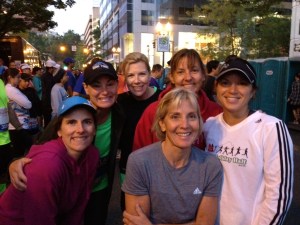
The day of event bands along the route and the big-hearted crowd with their snacks and cheers and good will felt more like Carnival than an athletic event.  There were aid stations every two miles with electrolytes, gummy bears, pretzels.  I had my running pals, some friends who jumped in to run along the way, my cousin, and others who had Cheezits just when I needed them.

Running Gang Before the Event.

Running Gang Before the Event

My old nemesis Piriformis announced herself at the beginning of the race, but not so badly I couldn’t ignore her.  Besides, it was entirely my fault she was still with me.  Until about mile 19, life was good.  7 miles to go and the harness was cinching and there was another hour of running and I couldn’t remember why I thought running a marathon was a good idea or even fun.  Crying, quitting, hitchhiking with that nice motorcycle guy who weaves in and out of the race, or joining one of the front yard red solo cup beer parties all seemed like reasonable choices.

But there I was, doing my just once marathon, my one and done, and I’d be damned if I was going to quit.  I wasn’t the only one feeling the burn.  Around mile 21 people around me began to walk, limp, stretch, lie down, you name it, it was happening.  One guy was throwing up gummy bears into the bushes.  Another took off his shoes, threw them on the sidewalk, and kept running in nothing but socks.

My cousin stuck with me, and I did more listening than talking; I don’t remember much about the last five miles, and then we were across the finish line, and someone was draping the foil blanket around my shoulders, and someone else gave me a medal, and I followed the line of finishers to the food station.  My friends and I wandered like zombies, dried sweat crystals on our faces and our lips pale.

I remembered about the crying from other events and understood, finally, that the tears are born out of relief and gratitude and exhaustion and exertion.  I didn’t cry but I did sit down and watch other runners making their way through the feed zone.  Only a few were crying.  Wrapped in their blankets, dazed, most of them looked as if they’d sustained some kind of trauma.

Friends have told me that after their first few marathons, they were so burned out they couldn’t bring themselves to run again for several months.  This urge hasn’t come for me.  What’s followed the event is pride in finishing, even though it took longer than I’d hoped, and a deep gratitude for running pals — I’d probably have abandoned the mission without them.  After a few days I hit the trail and shook out my legs.  They felt surprisingly good.

Still, I think I’m going to hang up my marathon shoes, stretch more and dump that bitch Piriformis, get back to the kind of running I love best – on the trails, with the dog, without a watch.  It’s a good pace for living.

Categories: girls, running, writing | Tags: , | 4 Comments

flown the coop

2013 - February to August 054

Around 7:20 each morning in the yard behind ours, a very vocal hen lays an egg.  This hen’s egg-laying aria (a reenactment here) is followed by irritable complaining about the state of things, and then, since I can’t see her, what I can only assume is some active scratching and feeding.  Her sisters lay eggs much later in the morning, usually together, making their own duet.  To be fair, if I had to expel an object that size every day, I’d have a thing or two to say about it, too.

I’m comforted by these new birds, and by how many folks in our neighborhood have chickens.  For now, listening from my yard is as close as I’m going to get to owning birds myself.  We’re renting a house.  Zora is allowed here, but nothing else.  The lease agreement expressly forbids chickens, cats, guinea pigs, rabbits, rats, mice, and any sort of reptile.  This list is followed by two exclamation points, which seems like a clause written for a bygone willful renter!!  Also in the lease is language about how I won’t do any yard maintenance, and that feels almost weirder than no chicken wrangling.

Hopefully, this limboed state of alert is temporary !!

Before we knew we were moving, we’d gotten new chicks, Ameraucana babies – Artemis and Athena, named by Riley.  I’d gotten them so we could diversify the flock and have green-blue eggs.  We brought them home in March, a cold one this year.  Because I was having problems moderating the temperature in their cage in the garage, the goddesses lived inside.

Chickens inside your house is a disgusting business.  Sure, Artemis and Athena were cute.  Sure, it was entertaining and unnerving watching the dog drool with longing, hanging her head over the side of the galvanized tub, quivering.  Sure, waking to the sounds of those little peeps from the breakfast nook (yes, they were near the kitchen, which is really, really disgusting), drinking coffee while listening to them practice being big birds wasn’t a bad way to start the day.

Sure.  They were cute and we held them and talked baby talk to them and told them how great their lives on our farm would be.  But chickens are filthy.  About week three the stink kicked in.  They shat in their food, in their water, on each other.  They scratched and made dust and filled their water dish with fecaled shavings.  Despite our efforts to keep the place clean, the dust from their quarters filtered into the house, as did the relentless scratching sound.  Artemis and Athena got older and smellier and the world outside got warmer, so we moved them to the garage to finish being babies before we introduced them to the big girls.

Giving the goddesses away was one of the first things we did when we decided to move.  They were high maintenance, they didn’t lay eggs and wouldn’t for several months.  I wasn’t so attached I was sentimental yet, so they went to live a few streets over with some friends of ours who’d just started their own chicken operation and had room for a few more.

The big girls – Ginger, Marianne, and Rainer (Mrs. Howell was a man.  We swapped her for Rainier)—were a different story.  My first bird children, I’d raised them up from babies, trained them to come when I whistled the opening bars of Vivaldi’s Four Seasons, benefitted from years of delicious eggs.

Also, I couldn’t get out of my head a scene like something from the Beverly Hillbillies, our truck piled high and the chickens in a wire cage on top of a jalopied heap, their feathers trailing in the wind behind us.

Also, there was that business of the no pets !! in our lease agreement.

It was harder than it would seem to find homes for them, what with their “advanced” age.  No one wanted new-to-them chickens who were probably going to stop laying within the year, even if they were gorgeous and tame and cleverly named.  In the end, Riley’s soccer coach Brett, who owns land and has twenty or so chickens already, agreed to take them.

We drove the girls out to Brett’s property a few weeks before we left.  He was ready for us, a separate cage set up near the main coop.

“I’ll toss them in tonight with the rest of the girls,” he said.  “Works every time.  They’ll wake up tomorrow and the others will be like, ‘Hey.  How’s it going?’ and that will be that.”

Inside a huge chicken run, his birds – five or six breeds altogether—were gathered around cantaloupe and watermelon halves, clucking and gorging themselves.  Brett had built the coop, his own design, also large and set up so his kids could easily gather eggs and clean it.  The place was like Club Med for chickens.

His four-year-old daughter Shey led me over to the chicken graveyard under a stand of cedars.  “This is our pet cemetery,” she said.  “Rosy the cat is here, too.” Several rocks brightly painted were scattered on top of the needles there.  “Also Blacky, Whitey, and Socks.”

“Cats?” I asked.

She shook her head.  “Hamsters.”

She gave me a tour through each stone and what was buried under it, and then skipped off to play with Riley on the tire swing.

We have a pet graveyard at our house where we’d buried a gecko, some goldfish, a dead wren we found on the deck, and a frog Riley found in the mailbox that she petted too much.  They’re buried there for closure’s sake, because it mattered to our kids, and because we couldn’t eat any of them.

But chickens are different, I think.  Their presence in our lives had been about more than love and nurturing.  Having them was symbiotic – I did a good job and they did too.  Our house wasn’t a chicken pleasure cruise.  When the girls stopped laying, our plan was to harvest them and make soup stock, a reminder for our whole family about not wasting resources and knowing how to do things for ourselves.

Still, I was charmed by Brett’s kids, four girls, who were fully involved in caring for their animals.  He never gathered eggs, the two younger ones did that.  His elder two did all the feeding and cleaning the coop.  The birds also came out to “play.”  They sometimes wore doll clothes and went to the front of the property on leashes.  Another look inside the coop revealed a chicken-sized rocking chair, filthy with chicken poop, and a window with gingham curtains.

When I asked Brett about it, he shrugged and said, “It’s more a petting zoo than a farm.”  He rubbed at his beard and looked over at the girls swinging.  “There’s a lot of…uh…estrogen out here.  ”

For Brett’s family, I guess that graveyard makes sense.  My bird girls will have a nice retirement at his estrogen ranch before they join the others under the cedars.  No soup pot for them.

Birdless for now, I guess it makes sense to scratch off the chicken wrangling headline on this blog.  I’ll have to live vicariously through my neighbors’ birds and the yards they tend themselves.

Hopefully, it’s only for a little while. !!

Categories: chickens, community, gardening, Uncategorized, writing | Tags: , , , | 2 Comments

found books

Spring was full of reading disappointments.  Either the book I chose had a stupid plot.  Or characters I couldn’t access.  Mystifying edits. Writing that made me feel I wasn’t in very capable authorial hands.  By May I had begun to despair.  I used to read every book to the bitter end,  the least I felt I could do to honor a writer’s hard-won journey to publication.  I don’t do that anymore – there’s too much great literature to read, too many bad books out there, and too little time.  Now I give a narrative 50 pages, and if it’s not working for me, I put it down.

It’s possible my problem this spring was mostly reader error, what with packing and being distracted, but I don’t think so.  Summer’s surprising, random, unexpected reading list broke several months of stories that failed to delight.  One thing I love best about these reads is the way they came to me.

From the “Take Me” shelf at the coffee shop:

When the Killing's Done

While I waited for my latte at the coffee shop, I looked through the “TAKE ME” bookshelf and found a tome about two centuries of opportunists exploiting the natural resources of the Channel Islands off the coast of California.  The promise of a couple generations of depletion from sheep ranching, a shipwreck that introduced rats to Anacapa, and one very passionate National Park Service conservationist Alma Takesue from the 21st century who wants to eradicate the rats on Anacapa to save a species of shore bird, made me take the novel home.  Always rich and believable, Boyle’s female characters tussle with the natural world and with their lovers.  Boyle is masterful at storytelling with a wide lens on generations and place, but he’s also good at the intimate landscaping that captures the dark forest, as Willa Cather calls it, of the human heart.  And while When the Killing’s Done is far from one of Boyle’s best works – even full as it is of shipwrecks, the sticky wicket of conserving species and how conservation is inextricably linked with destruction, and a very one-dimensional PETA-esque bad guy called Dave LaJoy who gets what’s coming to him on the heels of an act of revenge – in all ways that mattered most to me this summer, it was the perfect read at the right time because I was transported out of my world.

From a rusty wheelbarrow selling used books at a garden shop:

San Miguel

I had T.C. on the brain already.  In the city on my way somewhere else, I walked by a garden shop wheelbarrow and out of the corner of my eye caught the name Boyle. For $2 (sorry, T.C.), I picked up Boyle’s San Miguel, set again in the Channel Islands.  It’s another sheep island story, on a different island this time, and most of it set in the 19th century.  But in both When the Killing’s Done and San Miguel (published less than a year apart), Boyle is scratching an itch about generations of people discovering, exploiting, preserving, and resurrecting the natural resources of the Channel Islands, and the human drama behind such ambitions.  Both books are gritty romances, rife with relationships built upon punishment and power, lust and willful misunderstanding.  He’s fantastic at this emotional geography, map-making a world of tortured souls who often don’t know what they want, or worse, they do know, and their sometimes terrible desires become the gears of the story.  I get it.  An island is an interesting Petri dish for storytelling, with an ecosystem you can manipulate and experiment with, not to mention the outside world sailing over to disrupt the narrative.

I couldn’t put it down, because how could you not careen off the tracks with such characters as these?

From a pile of books a friend gave me:

12731708

Alan Bradley’s The Sweetness at the Bottom of the Pie.  This book had been on my bookshelf for several months, and I’d purposefully avoided it because of the cover, spring green with a bird and stamp on it that screamed of some saccharine story about women finding epistolary love.  While packing, I left out books from my collection that seemed like good summer reads.  Most of them were mysteries.  Another look at the synopsis of Bradley’s book piqued my interest, so it made the cut.  It took me almost the whole first book to realize that though Bradley’s narrator is a precocious, naughty and very determined eleven-year-old Flavia de Luce, the book isn’t really Young Adult, though on the surface it seems to be.  I liked the book so well I did a quick search to see what else Bradley has written and was gifted with the knowledge that there are FIVE Flavia de Luce books.  Oh boy.

I checked out the next three from the library, in LARGE PRINT, because those were the only versions they had.  And I was desperate.  In each of the books, set in the 1950s English countryside, Flavia works to solve a murder.  A crackpot chemist with her own chemistry lab in the abandoned wing of their ancestral English home, Flavia comes at problem-solving through science; in fact, a reader can learn a thing or two about chemistry from her.  But some of the best scenes are born out of the passages where we see Flavia acting as a child – mourning the death of her mother, plotting revenge against her two older sisters, looking for a way to talk with her father, who is wracked by grief and who deals with the imminent crisis of bankruptcy by losing himself in his stamp collecting.  The cast of characters flanking Flavia is, of course, also delicious – Dogger, her father’s valet, gardener, butler, and right-hand man, and also Flavia’s closest ally; Inspector Hewitt and his wife Antigone, whom Flavia half longs to be adopted by; her bike, Gladys, which used to be her mother’s and which ferries her to crime scenes and various investigations; and in each book, the characters who come through to people the world of the crime.  It’s delicious fiction – witty, smart, backlit by clever capers for which you can suspend disbelief — and the first time I’ve fallen for any books from the mystery section.

Bradley’s got another installment in the wings, Book Six, due out January 2014, and I’ll wait, mostly patiently, to continue the saga.

Also, there’s going to be a television series.  Oh dear.  Mixed feelings.

In the mail from a friend, because she knows I adore him:

Benediction

Kent Haruf’s Benediction.  A master at impaling his characters on the prongs of their foibles and choices, Haruf’s stories teem with regret and redemption.  His characters labor under the aftermath of failing to act, or emotionally sealing themselves against the world, and the reckoning that comes as a result of hiding from themselves.

His latest, Benediction, is again set in Holt, Colorado.  It’s more ambitious in some ways than his previous novels, in that it braids the lives of five or six sets of characters.  At the center of the narrative are Reverend Lyle, a newcomer from Denver who’s been transferred to Holt for some transgression we can only guess at, and Dad Lewis, dying of cancer, owner of the town’s hardware store, father of two children — one estranged son and one daughter who’s come back to care for him as he’s dying.  Writers are generally advised not to scaffold a story around cancer, a character dying from cancer, so I was skeptical such a seasoned writer would take this plunge.  But the presence of Lyle, a man of God, works to offset Dad’s life of harsh mistakes and complicates one of Haruf’s central questions about what it means to live an upright life.

Readers know, of course, that Dad Lewis is going to die from cancer.  Haruf establishes this on the first page.  We know his wife Mary is there to take care of him, that he’s agitated by regret.  While he waits to die, we see Dad’s life in flashback, which is to say we are transported to times for which Dad feels he must make amends – the firing of an employee and that man’s ultimate suicide, the way Dad alienated his son Frank.  The big question pulling a reader through the narrative is whether and how Dad’s going to see Frank again before he dies.  Except through morphined hallucinations, he never does see his son again, which is inevitable and heartbreaking and earned.  Dad’s absentee and sometimes harsh parenting and his tender care of others instead of his own family have brought him to this place of being alienated from his son, and it hurts like hell.

Readers also know that Reverend Lyle will do something to alter his path — he must have agency where Dad can only recollect his version of it from his deathbed, after all – but we don’t understand why Lyle doesn’t have a better relationship with his son, and what makes him fall away from the church, though it seems admirable enough after a life of passivity.  Still, I’m not sure he’s working to his potential as a character.

The heart of the story, then, is the disconnect between fathers and sons, the bond between mothers and daughters (Haruf has an affinity for stoic women; Benediction is rich in pairs of two generations of women holding what crumbles together), and the way, as in all of Haruf’s work, people quilt family out of the dust of loss and need.

I’ll forgive Haruf for the left turn at the end and its half-hitched deus ex machina with Alice and her bike, since I can see he was grappling with how to deliver the point home.  I was already crying my eyes out about Dad’s death, about Reverend Lyle’s inability to make a relationship with his son, even there in that dark garage.

We have to work for grace however we can, but there’s never enough time, which I guess is largely the point.

Categories: books, community, fiction, Uncategorized, writing | Tags: , , , , | 1 Comment

Earth. Wind. Fire

2013 Matches for Blog Post 005

Many years ago, when we lived in the Eastern Sierra, John and I were nearly evacuated from our home.  That summer, the Rainbow Fire brought firefighters from all over the West to our small mountain town.  Whether and how we’d have to leave was all people could talk about.  For over a week, the sky was heavy with blood-red smoke that occluded the sun.  We kept our truck packed with a few essentials, those we couldn’t bear to lose.  Just in case.  Firefighters saved the day then, as they will soon, I hope, in the hundreds of fires that rage now in the West.

Years away from that proximity to wildfire have made me forget how fire worry cloaks dry places in summer.  When we lived in Pennsylvania, I can’t remember one fire scare that didn’t involve a structure.  Floods were that region’s menace.  In our seven years there, the shed in our backyard flooded three times.  Next to a culvert which backed up every spring from heavy rain and idiotically designed drainage from a nearby golf course, the shed was full of things we’d carried from move to move.  Memorabilia, furniture, yard tools. One March evening John and I forged through our backyard in chest-high water and hacked a section of fencing away so the water could drain instead of flooding the house.

In the Pacific Northwest, late summer means smoke from fires east and south. My favorite woods are closed down by the timber company in August and September.  Just in case.  But in general, for many years, I have spoken of fires as not that near to us.  They are over there.

This year, fire has been on my mind pretty much since spring, when we decided to move.  It is a story both short and long, too tedious to report here, and is also the reason for the radio silence in this blog space.

John and I have moved a lot in our together life, each time purposefully, each time surprised we’re doing it again, each time mystified about the way our belongings have multiplied like those gremlins in that awful 80s film.  Moving means limbo and heartache, straddling the line between the love of one place and the hope about the next place.  It’s exhausting, exhilarating, overwhelming, terrifying.  The cleansing power of fire – a proper burn of most of our things and the party that would accompany it – was a solution I thought about more than I should have.

Before we moved, I ended up burning only a few things I’m not at liberty to report here, but suffice it to say there was (probably) too much beer involved.  Not as a retardant but as liquid encouragement.

The second night in our new town, which is in the high desert, we were jolted awake by a thunderstorm and a fire raging in the hills above town.  It was three o’clock in the morning.  The seven fire trucks worth of sirens I counted were ultimately eclipsed by the din of thunder above us, which boomed so loud it rattled the glasses in the cabinets and made the dog hide behind the toilet (I’m not sure why this was a safe zone, but she felt that it was).  The kids climbed into bed with us, and it would’ve felt like a scene from The Sound of Music, except that ash blasted into the house through the open windows until it occurred to us to close them.

The next morning we found all the surfaces in the house covered with chunky silt.  Parked on the street, our car looked like it had been in a ticker tape parade.

This.  Our new life.  We’ve moved from the one of the rainiest places in the West to one of the driest, a climate John and I haven’t lived in for fifteen years.  In the months that led up to being here, I made a habit of turning to John and telling him all our moving troubles and expenses could be solved by one thing.

“Oh yeah?,” he’d say, “What’s that?  A brigade of leprechaun movers?”

His ideas were different every time.  A team of furniture-hungry zombies.  The world’s biggest yard sale with a complimentary deep-fried bar – Oreos, pickles, butter.  A Dumptruck Demolition Derby, all the contestants loaded down with our household goods.  The crowd could trash-pick our stuff when the event was over.  The list was endless.

“Nothing so theatrical,” I’d say.  “I was thinking a book of matches.”

“Your solution lacks imagination.”

Maybe.

I didn’t think we’d move again, at least not this far away.  For months, while I packed up our belongings, I cursed the weight of them, the knickknacks and kitchen crap, the books (oh dear, I DO have a problem), the clothes and shoes and yard stuff and furniture.  I fantasized about using this life change as an opportunity to become a family of ascetics.  We could retrofit our trailer and practice micro living, everything we owned having more than one purpose.  Downsizing!  The next frontier!

With my truck:  Eleven trips of donated goods, one trip to give away items to family members, several more trips to deliver plants in pots and those dug up from the yard to friends, one trip to the food bank.  A massive neighborhood yard sale.  And still, we had too much crap.

I mean, what do we really NEED my high school lettergirl jacket for?  Or the skis John lost in an avalanche twenty years ago that we found the next spring?  Or the newspapers from 1875 wrapped in wax paper my great aunt gave me?

It turns out downsizing is a tricky business.  Even though we gave away so much, we still have too much to fit into our new house.  (I’m mostly sure we’re not hoarders). So we did what all good Americans do and put the overage of our lives in a storage unit.  Boxes upon boxes of it, where it will probably mold overwinter in the rainy Northwest, the plywood walls of the unit wet with condensation as so often happens, and then we’ll probably have to get rid of it anyway.  Maybe we’ll learn our lesson this time.

Now that the world is burning all around us, the thought of lighting matches doesn’t bring me much joy.  Each morning we wake to see what our day will bring.  Some days it is a “red flag warning” (a trifecta of wind, lightning and plenty of tinder).  Others it is an AQI (Air Quality Index) level Orange or Red (UNHEALTHY).  Above Red are Purple and Maroon, levels that are “HAZARDOUS.” We plan our time outdoors accordingly.  Morning is best.  In the afternoon it’s hot as balls, and the air reeks of fire and burns our lungs.

The kids have begun to ask what would make the world reach Purple or Maroon, and I don’t trust myself to answer, because of course I’ve imagined something apocalyptic already that involves much more than wildfires.  As a family, we keep our fingers crossed that fire will not be the thing to get us into those foreboding AQI colors.

Truthfully, now that I’m a high desert dweller again, I can’t make the joke about needing a book of matches without thinking about the loss of life and property this year’s fire season has already cost.

But at some point we’ll have to face the music with the rest of our things, and I’m pretty sure the leprechauns are not going to help us out.  I guess I’ll stow my matches for another time.  Just in case.  For when the rains come (I hear they do here), for when there’s not such a constant reminder of how nature is the boss of us.  For our next move.

Or maybe I’ll put my matches away for good.  Now that I’m thinking about it, John’s Dumptruck Demolition Derby idea isn’t half bad.  We DO have a county fair here…

Categories: demolition derby, writing | Tags: , , , , | 4 Comments

Create a free website or blog at WordPress.com.